

Blog
Lens Showdown: Three lenses. Three systems. Three creative identities.

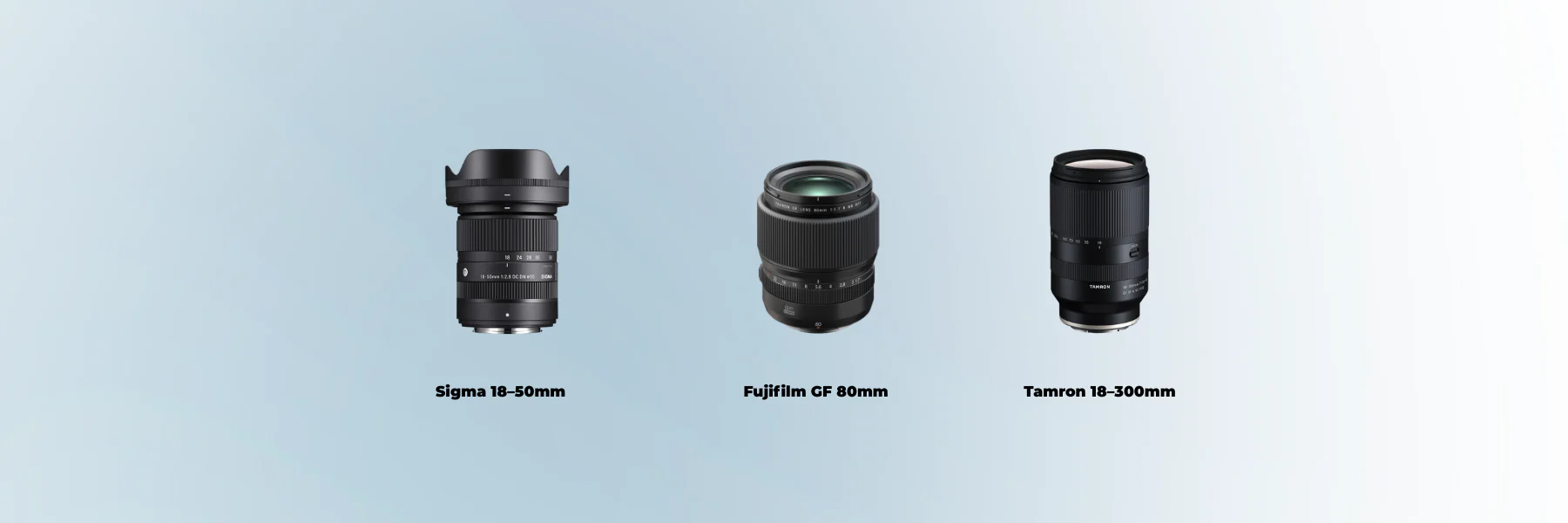
Sigma 18–50mm / Fujifilm GF 80mm / Tamron 18–300mm
Choosing a lens is often more important than choosing the camera itself. Today we compare three very different but highly popular lenses: the Sigma 18–50mm f/2.8, the Fujifilm GF 80mm f/1.7, and the Tamron 18–300mm f/3.5–6.3.
Each one serves a unique creator, system, and style—so let’s break down what they offer and who they’re best for.
The Everyday Workhorse for APS-C
Sigma 18–50mm f/2.8
The Sigma 18–50mm f/2.8 is one of the most popular compact zooms for APS-C mirrorless systems (Sony E, Fuji X, L-mount). It’s lightweight, fast, and extremely sharp for its size.
Why it’s great
• Constant f/2.8 aperture for low light & bokeh
• Super lightweight — perfect for travel and everyday shooting
• Sharp, clean images with great contrast
• Affordable compared to similar fast zooms
Trade-offs
• APS-C only (not for full-frame)
• Limited zoom range
• No built-in stabilization (relies on camera IBIS or OSS lenses)
Best for: students, travel shooters, content creators, vloggers, and anyone who wants a bright, versatile lens without the bulk.
The Medium-Format Portrait Master
Fujifilm GF 80mm f/1.7
The Fujifilm GF 80mm f/1.7 is a premium lens for the GFX medium-format line. With a full-frame equivalent of ~80mm, it’s built for stunning, high-end portrait work with exceptional depth and micro-contrast.
Why it’s special:
• Medium-format bokeh and depth unmatched in smaller sensors
• Ultra-sharp, with luxurious color rendering
• Weather-sealed, fast AF, and built like a tank
• Ideal perspective for portraits & fashion Trade-offs
• Large and expensive
• Limited to GFX medium-format users
• Not meant for fast action or casual use
Best for: professional portrait photographers, commercial shooters, fashion, editorial, and anyone who demands the absolute highest image quality.
The Ultimate All-in-One Zoom
Tamron 18–300mm f/3.5–6.3
The Tamron 18–300mm f/3.5–6.3 is an incredibly versatile super-zoom available for Fujifilm X and Sony APS-C. It covers everything from wide-angle to super-telephoto—in a single lens.
Why it’s impressive
• One-lens solution: wide → telephoto → macro
• Built-in VC image stabilization
• Surprisingly good optical performance for such range
• Lightweight compared to competing superzooms
Trade-offs
• Variable, slower aperture (not great in low light)
• Some distortion and softness at longer focal lengths
• Larger than a standard zoom
Best for: travelers, hikers, families, wildlife beginners, and creators who want one lens to shoot everything without switching.
✨ Final Thoughts
These three lenses couldn’t be more different—but that’s exactly why they shine. The Sigma 18–50mm is the compact everyday hero. The GF 100mm is the medium-format portrait powerhouse. The Tamron 18–300mm is the do-everything traveler’s lens. Together, they represent versatility, quality, and creativity across three unique systems.


 Film & Home Development